
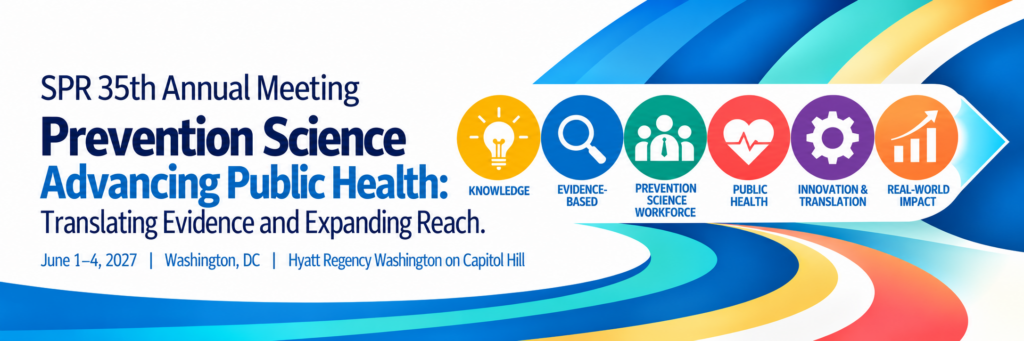
Prevention Science Advancing Public Health: Translating Evidence and Expanding Reach
Promoting health, especially child health, and preventing illness and chronic disease throughout the lifespan across physical, mental, and emotional health remains critical globally. Much of the chronic illness and disease burden is preventable, and population health is achievable. A major delay is the research-to-practice pipeline, which significantly reduces the promise of evidence-based and effective programs, services, and activities, particularly for populations most in need. Advancing research evidence for real-world impact needs to be accelerated.
Translating Evidence. Research results can take well over a decade to be implemented broadly in ways that benefit the public. This gap appears across a variety of health outcomes, including obesity, cancer, smoking and tobacco cessation, and mental, emotional, and behavioral health, to name just a few. Delays and challenges can occur throughout the process, from basic research through broad application.
A persistent challenge is translating rigorous evidence into information that is accessible, accurate, and usable for community members, practitioners, and knowledge users who determine which services, programs, and implementation strategies are adopted and sustained. We have accumulated a great knowledge base about mechanisms of effective prevention, such as risk and protective factors and implementation characteristics. We have accumulated information about effective services and programs tested in a variety of populations. We have research findings that show improvement in symptomology and health outcomes as well as financial benefits of investing in evidence-based prevention services and programs. We have summarized and disseminated this information in clearinghouses and registries, briefs, webinars, and a variety of other strategies. Why, then, does this gap continue, and what are solutions?
Expanding Reach. Epidemiological research consistently shows disparities across many physical, mental, emotional, and behavioral health issues, including HIV, cancer, obesity, cardiovascular health, mental health and illness, and substance misuse related to socioeconomic status, geography, race and ethnicity, disabilities, and sexual minority groups. Replicated research shows that individuals living in rural areas, those with lower income, or persons of color consistently experience the worst health outcomes. Disparities have also been identified in certain international populations. Disparities related to health, mental health, and other well-being supports and services, including evidence-based prevention and health promotion approaches also exist even when health insurance is available. Expanding reach is a complicated and multi-faceted issue; what are solutions?
The Society for Prevention Research: Crafting the future. The 2027 Society for Prevention Research Conference will dive into these complex and intersecting issues. What does the scientific process need to promote broad and sustained health improvements? The challenge involves not only generating strong evidence, but understanding how the evidence (e.g., effective preventive interventions, practices, and policies) can be adopted, adapted, implemented, scaled, sustained, and made accessible across real-world settings and for all populations. The goal of the conference is to explore these issues broadly in relation to health promotion and prevention of chronic disease and illness. In fine-tuning research translation and in expanding reach, the full impact of prevention and public health research can be realized.
2027 Special Conference Themes
Each year, SPR identifies three special themes, within the overarching conference theme, to highlight specific areas. SPR encourages basic, epidemiological, etiological, intervention, and dissemination and implementation research submissions across these special themes below.
Within these themes, SPR values submissions that utilize community-engaged research, particularly sessions that incorporate community or practitioner perspectives throughout the traditional research process and translation of research results to real-world impact. Sessions that directly address expanding reach to underserved or specialized populations are encouraged. We are especially interested in proposals focused on nutrition, chronic disease, digital media, environmental stressors, adverse childhood experiences, and sleep regulation. Proposals that consider how these issues intersect with mental, emotional, and behavioral health are also of interest.
Special Theme #1: Innovative Methods for Supporting Translation and Expanding Reach
The ability to translate prevention science findings into practice across populations is critical for addressing persistent disparities and improving the health and well-being of communities. This first special theme explores the importance of keeping in mind translation of research findings when designing your studies and how emerging analytic tools, technologies, methods, and designs can strengthen the identification of risk and protective factors, the development of interventions, and the evaluation of their impact across populations. This theme reflects prevention science’s continuing effort to harness innovation in service of broad application and better outcomes, without losing sight of scientific fundamentals that promote public trust.
Submissions should focus specifically on methods that accelerate translation, implementation, and real-world reach, including (but not limited to) underserved and specialized populations such as rural communities, military families, American Indian and Alaskan Native, and sexual minority groups. SPR invites submissions using qualitative and mixed methods that may identify crucial mechanisms supporting effectiveness, dissemination, and scale. Submissions using hybrid efficacy-effectiveness designs that focus on implementation factors help to blend the efficacy to effectiveness transition are also welcome. Methodology that engages community members, including youth, at the beginning of the research process are of utmost importance, such as community-based participatory research, human-centered design, and co-design/co-creation methods. Additionally, SPR invites work involving systematic and rapid reviews, meta-analysis, evidence mapping and gap identification, living reviews, harmonization of evidence across studies, triangulation across different evidence sources, practice-based evidence, rapid cycle research, and the responsible use of AI in evidence identification and synthesis.
Submissions in this special theme will answer the questions: Which innovative data syntheses, designs, and methodologies facilitate broad real-world impact? And, how? By contributing to this theme, authors will help advance prevention science’s capacity to translate findings into actionable solutions, inspiring new approaches to bridge the gap between science and practice and expand the reach of prevention science.
Special Theme #2: Strengthening the Prevention Science Workforce
The prevention science workforce plays a vital role in translating evidence-based practices into real-world impact, ensuring the health and well-being of communities worldwide. This second special theme focuses on how prevention science connects with the people doing prevention in communities. This workforce is vast and multidimensional with diverse education, training, and experience. The prevention workforce includes:
- Individuals who work directly or indirectly to support the health and well-being of individuals, families, and communities, including, but not limited to: community health / public health workers; public health nurses; home visitors; youth-and family-serving community non-profit organizations; Extension Educators; mental health and guidance counselors; social workers; drug prevention specialists; educators; positive youth development and prevention professionals, community coalitions; trainers and technical assistance providers, intermediary organizations; systems change specialists, implementation specialists, program coordinators, etc.
- Individuals who work in many different settings or types of organizations, including (but not limited to) healthcare, schools, human and social service agencies; non-governmental organizations, and community organizations such as positive youth development and family resilience programs and organizations, often in the not-for-profit world.
- Individuals who engage with a variety of specialized populations such as those with documented disparities such as low socioeconomic status, underserved rural communities, various racial or ethnic groups such as Alaskan Native or American Indian, people with disabilities, the military, sexual minorities, or etc.
Individuals in these varying workforce roles, serving various populations and working in different settings would likely need common knowledge, skills, and experience along with some specialized knowledge, experience, and skills. Connecting with and professionalizing such a broad workforce is a major challenge for the field.
Submissions are invited in, but not limited to:
- Identifying who makes up the prevention workforce, how to connect with them, and how to better understand their needs.
- Describing training programs, continuing education programs, credentialling and other systems that currently exist or can be developed to keep the prevention workforce up to date on emerging evidence, including successful integration of new knowledge and skills into their daily practice, and their current level of effectiveness.
- Supporting the well-being and retention of the prevention workforce, especially considering the workforce’s unique charge and complex positionality, both nationally and internationally.
- Sharing how the prevention workforce has been engaged in designing and building education, training, and technical assistance programs, and their outcomes.
Submissions in this special theme will explore the many challenges and potential solutions, across practice, procedures, systems, and guidelines that relate to strengthening the prevention science workforce that can accelerate research to public impact. Strengthening this multidimensional workforce is critical to advancing prevention science and improving outcomes for youth, families, and communities.
Special Theme #3: Engaging with Systems and Knowledge Users
This third special theme examines how researchers (i.e., knowledge producers) communicate, engage, and partner with public and private systems and knowledge users, especially those in leadership and decision-making roles in local communities, counties, states, national, and international audiences. Research findings can help inform decision makers in federal, state, and local health departments, other government agencies, communities, healthcare providers, employers, schools and research organizations. The policies and procedures adopted in these contexts shape the behavioral norms and practices that lead to broad health outcomes. This area focuses on how prevention science research findings can be communicated in accessible and useable ways with community leaders and knowledge users at all levels and across community sectors.
Submissions in this theme can:
- Look at effective approaches to disseminate results of prevention science-related research, including basic research findings, the effectiveness of specific prevention programs or activities, or dissemination systems and infrastructure needs.
- Examine how researchers and public/private systems can work together to identify evidence needs, generate relevant evidence, and support its use in decision-making and practice.
- Share effective engagement approaches that begin with the end in mind, including bidirectional, co-creative, or participatory approaches.
- Share communication or engagement strategies that are being tested, are in development, or are new ideas not yet tested.
This theme also draws on decades of accumulated research and experience of community coalitions, as key community-level prevention science knowledge users. This work has focused on the effectiveness of structured and unstructured technical assistance, feedback on coalition functioning, trainings, implementation science, community engagement, and tools for assessing readiness.
Submissions in this theme will focus on or will share an understanding of a particular prevention science-relevant audience, including a particular public or private system, funder, or another decision-making role. This theme addresses the ongoing challenge of moving prevention services and programs, prevention science knowledge and processes, and implementation science from carefully controlled research studies into everyday practice with fidelity, broad reach going to scale, and lasting impact on health. It emphasizes partnership among researchers, health and well-being practitioners, and the organizations and systems responsible for delivering prevention programming and treats the translation of evidence into practice as itself a subject worthy of rigorous study, accelerating the research to public impact timeline.
General Research/Science Areas
Each year, the SPR Conference committee encourages submissions within the following research/science areas:
Epidemiology and Etiology: Submissions focused on describing distributions and patterns of health (including but not limited to, e.g., mental health, substance use, cancer, cardiovascular disease, HIV/AIDS, injury, violence) and on identifying risk and protective targets of preventive interventions are welcomed. Submissions with a developmental and/or life-course approach, or that include genetic, neurobiological, health disparities, and/or contextual factors, are particularly encouraged. Submissions such as literature reviews, systematic reviews and scoping reviews are welcomed.
Development and Testing of Interventions: Preventive interventions can be tested for efficacy under conditions of high quality-assurance and strong research designs and tested for effectiveness under real-world conditions in settings and systems and with diverse populations. Submissions reporting findings from efficacy or effectiveness trials (including pilot studies with preliminary outcome data) are welcomed. Submissions such as literature reviews, systematic reviews and scoping reviews are welcome. Submissions that combine the findings of such trials with one or more of the special conference themes are particularly encouraged.
Dissemination and Implementation Science: Dissemination, implementation, and translational science bridge the gap between research and everyday practice through a dynamic, collaborative process between the public health community and researchers. Submissions advancing scientific understanding of dissemination, implementation, and translation, including cost-efficient sustainability of preventive interventions into systems, are welcomed. Submissions that focus on program dissemination and implementation outcomes, dissemination and implementation processes, individual-, provider-, organizational-, and/or system-level factors, and community- and system-collaborator and decision-maker engagement are particularly encouraged. Submissions such as literature reviews, systematic reviews and scoping reviews are welcomed.
Research, Policy, and Practice: Decision-makers around the world emphasize evidence-based policy reform. New policy initiatives at local, state, and national levels require scientific evidence to guide further policy change. Submissions that evaluate or estimate the effects of planned, new, or existing policies, examine the impact of efficacious programs in emerging policy contexts, or demonstrate how empirical research has been used to inform and guide new policies are welcomed. A wide variety of content areas are welcomed, including both emergent areas (e.g., autism, nutrition, suicide hotlines, school cell phone bans, AI) and ongoing areas (e.g., impacts of extreme weather, cancer screening, education policy, medication adherence, mental and physical health parity, obesity prevention) of concern. Submissions that describe and evaluate processes by which policies have been formed, developed, and implemented are encouraged. Submissions such as literature reviews, systematic reviews and scoping reviews are welcomed. Submissions focused on international research or comparative research across policy contexts and submissions that combine findings of such research with one of the special conference themes are particularly encouraged.
Innovative Methods and Statistics: Submissions focused on “leading-edge” study designs and analytical approaches that address challenges to unlocking information contained in prevention science data, including studies on quantitative, qualitative, and mixed methods approaches, are welcomed. Submissions that use advanced methods and statistics but do not study directly a novel methodological or statistical question should be submitted to one of the other themes. Submissions addressing novel methodological or statistical challenges in studies addressing health disparities are particularly encouraged. Submissions should highlight the prevention science challenges that these innovative designs and approaches can address, as well as the benefits gained by using these techniques. Submissions such as literature reviews, systematic reviews and scoping reviews that focus on the previously mentioned topics are welcomed.
International Drug and Alcohol Use Prevention Poster Session: Please view the separate call for international poster abstracts here.
NEW FOR 2027!
It is VERY IMPORTANT to note that there is a new step in the Abstract Submission Process.
When you are submitting your abstract there is now a TWO-STEP process when selecting your Special Conference Theme and your General Research/Science Areas. To do this, after you start your abstract submission and indicate your title, you will go to the Research/Science Theme Tab. From here, do the following:
1st Step: Select one of the FIVE (5) Research/Science Areas.
- Epidemiology and Etiology
- Development and Testing of Interventions
- Dissemination and Implementation Science
- Research, Policy, and Practice
- Innovative Methods and Statistics
2nd Step: Select one of the THREE (3) Special Themes, if it is relevant to your research.
- Special Theme #1: Innovative Methods for Supporting Translation and Expanding Reach
- Special Theme #2: Strengthening the Prevention Science Workforce
- Special Theme #3: Engaging with Systems and Knowledge Users
- Not Applicable – Select this option if your abstract does not fit within any of the descriptions provided for the special themes.
Please note that selecting one of the three (3) Special Themes does not have any value in the review scoring process. If your research is not applicable to a Special Theme, select “Not Applicable.”
This will not have any impact on your review score. Selection of a Special Theme is more a means of categorization, e.g. for scheduling purposes.
Please don’t hesitate to contact Jennifer Lewis at jenniferlewis@preventionresearch.org if you have ANY questions about the selection of the General Research/Science Areas and the Special Themes.
Submission Resources
View or download the complete 2027 SPR Annual Meeting Call for Papers.
Review the complete instructions for preparing and submitting a 2027 SPR Annual Meeting abstract.
Review the Research Foci questions that must be completed for each abstract submission.